Hello from Botswana! What a wonderful place, with incredible sights, people, and experiences again. We're sorry it's been several days since our last update. As we enter a new country it seems to take a few days to get internet access again (a mobile internet logistics update is mostly written, and will follow when we get a chance). All's well here. After Katima Mulali on the Caprivi Strip in Namibia, we crossed into Bots and stayed for three nights in Kasane, where we had a few driven and boat game tours - incredible, up-close animals - more to follow on that. We've now driven down to Maun, at the bottom end of the Okavanga Delta, and have arranged for a scenic flight into an overnight camp near the panhandle of the delta (boat access only, no power, etc.), with a return flight to Maun late tomorrow (Friday). We'll then drive back up from Maun and into Zambia, to stay in Livingstone on Saturday and Sunday nights, see Victoria Falls and do a few more activities. The plan is then to fly from Livingstone to Cape Town on Monday afternoon, and cross our fingers for a day in Cape Town that we'll be able to fly on Wednesday through Amsterdam and back to Vancouver. The contingency plan will be to try to get a flight from Cape Town through Atlanta or New York and then on to Vancouver.
Thanks for the comments and e-mails - we're looking forward to seeing everyone again, but enjoying every minute in the interim. There'll be more to follow of course - photos and a better description of the journey (from Liisa).
Cheers,
WilkinsonSix.
Thursday, April 22, 2010


Sunday, April 18, 2010
"Wilkinson Six and the Volcano"
Sounds like a good children's novel doesn't it?
Seeing as our flight to Cape Town via Amsterdam passed directly over Iceland, it would appear our return flight (scheduled for the 28th) will likely be interrupted, delayed, or cancelled. So, we'll be contacting KLM (a short wait on the phone, I'm sure), our trip cancellation insurance provider and Visa to see what we can do - perhaps a re-route through New York or Atlanta? Not sure yet.
We'll keep you posted!
Cheers,
J.
-- Posted From My iPhone
Seeing as our flight to Cape Town via Amsterdam passed directly over Iceland, it would appear our return flight (scheduled for the 28th) will likely be interrupted, delayed, or cancelled. So, we'll be contacting KLM (a short wait on the phone, I'm sure), our trip cancellation insurance provider and Visa to see what we can do - perhaps a re-route through New York or Atlanta? Not sure yet.
We'll keep you posted!
Cheers,
J.
-- Posted From My iPhone
Etsoha National Park
Etosha National Park – ‘Great White Place of Dry Water’

We entered Etosha through the west gate at Okaukuejo, and we were immediately impressed by the resort. A few years ago, the facility was upgraded and the new lodges, restaurant and facilities are modern, yet beautifully kept in the African construction, decor and theme. The kids were happy to see the large welcoming, swimming pools, and the setting seemed more like a well-heeled resort, than a national park facility.

I had read earlier in a local newspaper, that the Namibian president referred to Etosha as the ‘milk-cow’ of the country, in reference to the revenues it generates, so I presume the upgraded facility attracts many travellers. Thus far, outside of the Easter weekend in South Africa, our travels have been relatively quiet in regards to tourists or crowds and we have heard that the peak season for travelling Namibia is June-September (more of the dry season). This would make sense for regular family travellers who would overlap school holiday months. Namibia is currently at the end of the wet season, and northern Namibia has had a couple of very wet months (if you call 290 mm of rain the whole month alot!). This is great for the farmers, wildlife and local people, but it also means that the wildlife within the parks do not have to come to the waterholes and therefore game viewing can be challenging. Needless to say, we were happy to settle into the resort, hang out at the pool and order a few Savannas (the local yummy cider). John was feeling a bit under the weather, with a cold and some on and off fever, and we were all a bit concerned that it did not escalate to anything more so he rested for the first afternoon. I booked an afternoon game drive with a guide and the kids, to start our Estosha large animal viewing.

Estoha Park is over 22,000 square kilometres, with the western half of the park only available to private tour operators and the eastern section open to the public. It is one of the few parks where you can independently self-drive through the park (as long as you stay in your vehicle and on designated roads). It surrounds the Etosha Pan and a few smaller pans which are historic inland lakes that dried up when the course of the Kunene River was changed by Plutonic movements. The salt deposits created a super-saline pan, which sustains little life and is therefore largely predator free which allows the wildlife to migrate between waterholes during dry season. Arriving in the wet season meant there was some water in the pan and the surrounding grasslands were green, with small flora, acacias and mopane trees. We arrived at the tour bus site a few minutes late, just in time to see our large bus leaving, with the kids running behind chasing the driver. Some things in Africa seem to take a long, slow time, but obviously game drives are punctual. Luckily for us, the reception arranged for a private tour on a 4x4 safari vehicle, so we were off within the half hour. The kids enjoyed the drive and our guide had seven years of knowledge within the park. We saw hundreds of zebras, giraffes, ostrich, springbok, gemsbok, blue wildebeest, blackbacked jackal, side stripped jackal, kudu, impala and we went into the lions den (but no lions). We also saw various different birds of the area, many with interesting and vibrant colours. We heard a lot about the wildlife habitats and interesting facts about their behaviour. Our guide helped us with identification of the various species and was apologetic that at this time there was no big game (elephants, rhinos) and the pans edge. We were pleased with our sightings and shared our findings when we returned back to Okaukeujo.


Namutoni (the eastern resort location in the Park) is equally as nice as Okaukuejo, just a different theme. This resort (which is the eastern most area of Etosha) is based on an old fort for German South Africa, which was established in 1904. There is a raised boardwalk system here and a waterhole, which has a light and viewing area for night watching. It is located near a small Pan, Fisher and is an easy 25 km round the pan for game viewing. We started by going to the water hole at night, where we saw herds a zebra and springbok coming to enjoy a drink at the hole. The next day we ventured out to see if we could spot an elephant, on our drive from Okaukuejo to Namutoni we spotted numerous elephant dung droppings and large broken branches, but no elephants. We had been told that with the amount of water available, the herds had migrated to the interior of the park. These creatures walk over 60 km per day, so at any time it is difficult to predict where they may be. We slowly toured early morning around the Fisher Pan, seeing an abundance of the same animals, and a variety of birds. When all hope had been lost, and I was at the wheel with John resting in the rear, I spotted an elephant trying to hide behind a bush! The majestic creature had his two ears, flapping back and forth behind a large green bush. He appeared to be a larger older male, with his left tusk broken off and moved in a slow, meaning way. Of course, the whole van came to life as we watched the elephant move from behind the bushes to full view, then cross the road 3 m from our van, and over to the water hole to cool down. We were the only car experiencing this wonderful sight in nature, and we all relished in our triumph. We left Estosha with a new appreciation for the animals of the park, and the wonders of the African pans.


We entered Etosha through the west gate at Okaukuejo, and we were immediately impressed by the resort. A few years ago, the facility was upgraded and the new lodges, restaurant and facilities are modern, yet beautifully kept in the African construction, decor and theme. The kids were happy to see the large welcoming, swimming pools, and the setting seemed more like a well-heeled resort, than a national park facility.

I had read earlier in a local newspaper, that the Namibian president referred to Etosha as the ‘milk-cow’ of the country, in reference to the revenues it generates, so I presume the upgraded facility attracts many travellers. Thus far, outside of the Easter weekend in South Africa, our travels have been relatively quiet in regards to tourists or crowds and we have heard that the peak season for travelling Namibia is June-September (more of the dry season). This would make sense for regular family travellers who would overlap school holiday months. Namibia is currently at the end of the wet season, and northern Namibia has had a couple of very wet months (if you call 290 mm of rain the whole month alot!). This is great for the farmers, wildlife and local people, but it also means that the wildlife within the parks do not have to come to the waterholes and therefore game viewing can be challenging. Needless to say, we were happy to settle into the resort, hang out at the pool and order a few Savannas (the local yummy cider). John was feeling a bit under the weather, with a cold and some on and off fever, and we were all a bit concerned that it did not escalate to anything more so he rested for the first afternoon. I booked an afternoon game drive with a guide and the kids, to start our Estosha large animal viewing.

Estoha Park is over 22,000 square kilometres, with the western half of the park only available to private tour operators and the eastern section open to the public. It is one of the few parks where you can independently self-drive through the park (as long as you stay in your vehicle and on designated roads). It surrounds the Etosha Pan and a few smaller pans which are historic inland lakes that dried up when the course of the Kunene River was changed by Plutonic movements. The salt deposits created a super-saline pan, which sustains little life and is therefore largely predator free which allows the wildlife to migrate between waterholes during dry season. Arriving in the wet season meant there was some water in the pan and the surrounding grasslands were green, with small flora, acacias and mopane trees. We arrived at the tour bus site a few minutes late, just in time to see our large bus leaving, with the kids running behind chasing the driver. Some things in Africa seem to take a long, slow time, but obviously game drives are punctual. Luckily for us, the reception arranged for a private tour on a 4x4 safari vehicle, so we were off within the half hour. The kids enjoyed the drive and our guide had seven years of knowledge within the park. We saw hundreds of zebras, giraffes, ostrich, springbok, gemsbok, blue wildebeest, blackbacked jackal, side stripped jackal, kudu, impala and we went into the lions den (but no lions). We also saw various different birds of the area, many with interesting and vibrant colours. We heard a lot about the wildlife habitats and interesting facts about their behaviour. Our guide helped us with identification of the various species and was apologetic that at this time there was no big game (elephants, rhinos) and the pans edge. We were pleased with our sightings and shared our findings when we returned back to Okaukeujo.


wildebeest


The next few days we did self-drive safaris and discovered that the van can serve as an excellent ‘safari vehicle’ with the side door open, fully-decked out with refreshments and lounge areas. Our drives led us to see a leopard (which is a rare sighting in the park) who was strolling down the side of the road, in the heat of the day, then moved off to the side in the long grass. We also sighted 3 cheetas, in the long grass, maybe 10 metres from the van. It was a beautiful sight with their coats blending into the long grasses. They stood in a line, with each one of them on guarding their own direction with their heads turning only slightly as the wind shifted. At the end of one of the days, just before dusk, we drove alongside a small wooded area surrounded by plains. We watched and counted in amazement at all the different animals grazing alongside the wooded area – giraffe, wildebeest, springbok, gemsbok, zebras all intermingled amongst each other. As we slowly pulled away, we sighted one lion, then two, then the whole pride (over 12), all female with one male. We watched as the female hunters prowled along the grassed area, towards a few Wildebeest, that had wondered off from the wooded area. With incredible skill and patience, the female hunters started their approach on the prey, always being cautious of staying downwind. One Wildebeest must have spotted one lion, and suddenly starting making loud grunting and snorting noises, to warn the other which was closer to the pride. The lions did not make any fast motions, and stood their ground. The male never once moved from his spot, and later we learned that this pride would have one kill every 2 days, which all would feed on. Lions in the park prefer the zebras, but a large Wildebeest would also be just fine. It really was an amazing experience to see how these animals interact and exist in their natural habitat, and we all watched the sunset over the pan before rushing off to make the sunset gate closing at Namutoni (at this gate the alarm bells go off and the gate mechanically locks down!).
Namutoni (the eastern resort location in the Park) is equally as nice as Okaukuejo, just a different theme. This resort (which is the eastern most area of Etosha) is based on an old fort for German South Africa, which was established in 1904. There is a raised boardwalk system here and a waterhole, which has a light and viewing area for night watching. It is located near a small Pan, Fisher and is an easy 25 km round the pan for game viewing. We started by going to the water hole at night, where we saw herds a zebra and springbok coming to enjoy a drink at the hole. The next day we ventured out to see if we could spot an elephant, on our drive from Okaukuejo to Namutoni we spotted numerous elephant dung droppings and large broken branches, but no elephants. We had been told that with the amount of water available, the herds had migrated to the interior of the park. These creatures walk over 60 km per day, so at any time it is difficult to predict where they may be. We slowly toured early morning around the Fisher Pan, seeing an abundance of the same animals, and a variety of birds. When all hope had been lost, and I was at the wheel with John resting in the rear, I spotted an elephant trying to hide behind a bush! The majestic creature had his two ears, flapping back and forth behind a large green bush. He appeared to be a larger older male, with his left tusk broken off and moved in a slow, meaning way. Of course, the whole van came to life as we watched the elephant move from behind the bushes to full view, then cross the road 3 m from our van, and over to the water hole to cool down. We were the only car experiencing this wonderful sight in nature, and we all relished in our triumph. We left Estosha with a new appreciation for the animals of the park, and the wonders of the African pans.


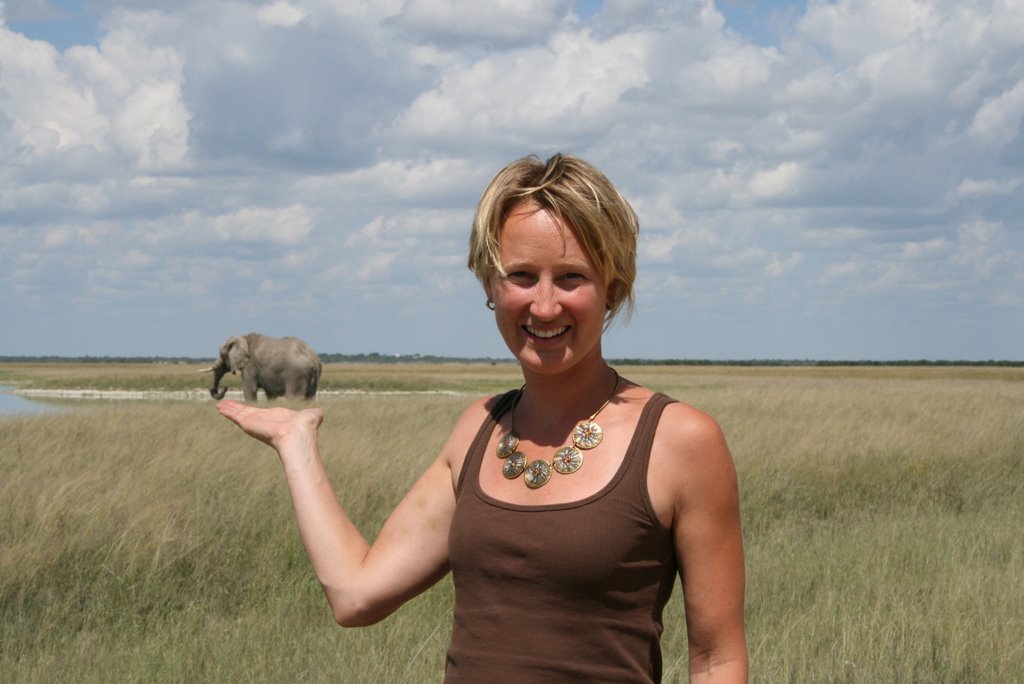
Saturday, April 17, 2010
Apologies - that's the Kavango River, not the Zambezi
I had to correct that before Mr. Gosney did! But then again, the river name is probably of greater interest to the Salvation Army than someone reading a blog from Canada ...
Ciao! J.
-- Posted From My iPhone
Ciao! J.
-- Posted From My iPhone
Namibia Interrupted
Unfortunately the Zambezi River is at near-record-highs, putting this picnic / braii area under

water, and potentially

altering our travel plans.
More seriously though, the locals are in need of assistance, so local and international aid agencies are present to help (aside: every dollar donated to the Salvation Army is a dollar well spent!).
The Okavanga and Chobe parks in Botswana, southern Zambia have been subject to very high rainfalls over the past couple of weeks, so our plans may have to adapt. Our plan for today is to drive through to the northeast end of the Caprivi Strip and re-assess.
Cheers from Rundu!
-- Posted From My iPhone

water, and potentially

altering our travel plans.
More seriously though, the locals are in need of assistance, so local and international aid agencies are present to help (aside: every dollar donated to the Salvation Army is a dollar well spent!).
The Okavanga and Chobe parks in Botswana, southern Zambia have been subject to very high rainfalls over the past couple of weeks, so our plans may have to adapt. Our plan for today is to drive through to the northeast end of the Caprivi Strip and re-assess.
Cheers from Rundu!
-- Posted From My iPhone
Location:Rundu, Caprivi Strip, Namibia
Friday, April 16, 2010
Waterberg National Park
Waterberg Plateau

We decided to leave the coast and head interior to the Namibia Wildlife Resort (NWR) of Waterberg Plateau, a 50 km long and 16 km wide park area. This protected area hosts and breeds rarer species of wildlife, that the larger parks do not have. Mostly they can accomplish this by keeping out the more aggressive species, like the lions, tigers and rhinos. The plateau is an abnormal geological formation of an orange-red sandstone plateau which rises 150 m with sheers cliffs on all sides and sticks out in the horizon like an elevated mass. The NWR parks all run on the same schedule, gates open at sunrise and shut at sunset, and the gatekeepers are instructed to keep strict to these schedules (more on this later, reoccurring theme). Once again this meant we were pushed for time to get there before sunset. We had asked before we left Swakapmond how long the drive would be and were told 5 hours, but we have come to learn that Namibians must drive a lot faster, since most of the time we are at least 50% longer! After over 6 hours of driving, we turned off the main road (B1/C22) and headed towards Waterberg, just before the sun was setting, only to realize that we had limited gas (diesel) and had to loop back to fill up prior to our last stretch of gravel road driving. This detour meant we would be driving in the dark again, not a desirable situation. Our last 25 km of dark gravel road driving was nothing short of terror, we had a pickup truck filled with guys and ‘animals’ cages’ in the back tailgate us, then pass us – and I was sure they were poachers who would certainly not want us get in their way. Then we came upon a series of gates (not uncommon on some of these gravel roads where they are protecting wildlife and livestock). At the gates were security guards, who looked at us and asked why we would be travelling so late (remember that sunset is 6:15 pm, so this would have been maybe 7:30 pm), to top it off we missed the park entrance cut off and went up a steep, sandy road only to need to u-turn back. No one was happy when we finally hit the park gates and tried to explain to the gatekeepers why we were late. Reluctantly, they took pity on our situation and welcomed us into the park, noting that the office was closed and we would need to check in the morning to register and pay (registering at these resorts is a whole other story, let’s just say they do it the old-school way with log books and it is time consuming).
The blessing was that the resort was fantastic, and it was like walking into a scene from one of the safari movies. A large spacious restaurant, outfitted with African decor and art, candelabras, and to top it off a beautiful traditional outdoor buffet, was waiting for us. There was several other trekkers (mostly older Germans), all enjoying themselves immensely. We dined, drank, washed up and slept sounding till 5:30 am (dawn) the next day, when we started our Game Drive.
Game driving is a serious event; you need to be up early, quiet, attentive and on the ball to see the wildlife. It is a completely different experience then going to a zoo, where the animals are within a viewing area. A Game Drive is going in a 4x4 vehicle, essentially through the bush, to try and find where the animals may be grazing, eating, walking. The guide needs to rely on tracks, time of day, weather, previous spottings, etc. And as we have been told, “there are no guarantees as to what you may see, this is nature”. The biggest game in this reserve was the White Rhino – which was on the extinct list – and is being bred here, and secretly it is what I was hoping to see. Unfortunately, we never got to see one. We did however see a variety of other animals, starting with the Bush pigs (Warthogs) who were grazing as soon as we left at the bottom of the plateau. We also saw giraffes, sable, roan, springbok, gemsbok, oryk, kudo, impala, zebra and a whole clan of baboons, who we learnt were very mischievous creatures. We had heard the Baboons crying and howling in the morning, and could not figure out what the noise was. We were told that they love to come down from the mountain top and rummage through anything at the resort.


We also came across a chameleon crossing our path and spent some time observing it’s behaviour, how it continuously changes colour and puffs it’s self up to look bigger when threatened. We marvelled at the way it walks – and the kids developed their own chameleon dance, with Anna even adding dancing and song.


We left the resort and headed to a town 100 km away, with a well-known German bakery (which we read about in our tour book), for lunch on route to Estosha National Park. As we parked outside of the bakery, we noticed that one of the NWR game vehicles was pulling in behind us. Two of the Waterberg resort workers came over to our van and started to explain how they had been trying to get a hold of us (essentially tracking us), since there had been a mistake made. We had no clue what they were talking about, but eventually we came to learn that they had ‘double-charged our credit card for $4000 Rand, instead of $ 2100 Rand’, and were ‘tracking’ us to give us the money back. They did not know our route plans, but had deduced that if we were not going to the Bakery (obviously this is a hot-spot for tourists), then Windhoek (a 300+ km drive) would likely be where we would stop for gas. When I asked them if they would have driven to Windhoek to give us the money back, they looked at us with all sincerity and said, yes of course. They handed us the $2000 Rand cash ($300 Cnd) with apologies of the accounting error, of which we gave them back $300 R ($45 Cnd), and wished them safe travels on their return trip back to Waterberg. We suspect that the daily animal tracking skills also helps tracking down other species when required!

We decided to leave the coast and head interior to the Namibia Wildlife Resort (NWR) of Waterberg Plateau, a 50 km long and 16 km wide park area. This protected area hosts and breeds rarer species of wildlife, that the larger parks do not have. Mostly they can accomplish this by keeping out the more aggressive species, like the lions, tigers and rhinos. The plateau is an abnormal geological formation of an orange-red sandstone plateau which rises 150 m with sheers cliffs on all sides and sticks out in the horizon like an elevated mass. The NWR parks all run on the same schedule, gates open at sunrise and shut at sunset, and the gatekeepers are instructed to keep strict to these schedules (more on this later, reoccurring theme). Once again this meant we were pushed for time to get there before sunset. We had asked before we left Swakapmond how long the drive would be and were told 5 hours, but we have come to learn that Namibians must drive a lot faster, since most of the time we are at least 50% longer! After over 6 hours of driving, we turned off the main road (B1/C22) and headed towards Waterberg, just before the sun was setting, only to realize that we had limited gas (diesel) and had to loop back to fill up prior to our last stretch of gravel road driving. This detour meant we would be driving in the dark again, not a desirable situation. Our last 25 km of dark gravel road driving was nothing short of terror, we had a pickup truck filled with guys and ‘animals’ cages’ in the back tailgate us, then pass us – and I was sure they were poachers who would certainly not want us get in their way. Then we came upon a series of gates (not uncommon on some of these gravel roads where they are protecting wildlife and livestock). At the gates were security guards, who looked at us and asked why we would be travelling so late (remember that sunset is 6:15 pm, so this would have been maybe 7:30 pm), to top it off we missed the park entrance cut off and went up a steep, sandy road only to need to u-turn back. No one was happy when we finally hit the park gates and tried to explain to the gatekeepers why we were late. Reluctantly, they took pity on our situation and welcomed us into the park, noting that the office was closed and we would need to check in the morning to register and pay (registering at these resorts is a whole other story, let’s just say they do it the old-school way with log books and it is time consuming).
The blessing was that the resort was fantastic, and it was like walking into a scene from one of the safari movies. A large spacious restaurant, outfitted with African decor and art, candelabras, and to top it off a beautiful traditional outdoor buffet, was waiting for us. There was several other trekkers (mostly older Germans), all enjoying themselves immensely. We dined, drank, washed up and slept sounding till 5:30 am (dawn) the next day, when we started our Game Drive.
Game driving is a serious event; you need to be up early, quiet, attentive and on the ball to see the wildlife. It is a completely different experience then going to a zoo, where the animals are within a viewing area. A Game Drive is going in a 4x4 vehicle, essentially through the bush, to try and find where the animals may be grazing, eating, walking. The guide needs to rely on tracks, time of day, weather, previous spottings, etc. And as we have been told, “there are no guarantees as to what you may see, this is nature”. The biggest game in this reserve was the White Rhino – which was on the extinct list – and is being bred here, and secretly it is what I was hoping to see. Unfortunately, we never got to see one. We did however see a variety of other animals, starting with the Bush pigs (Warthogs) who were grazing as soon as we left at the bottom of the plateau. We also saw giraffes, sable, roan, springbok, gemsbok, oryk, kudo, impala, zebra and a whole clan of baboons, who we learnt were very mischievous creatures. We had heard the Baboons crying and howling in the morning, and could not figure out what the noise was. We were told that they love to come down from the mountain top and rummage through anything at the resort.


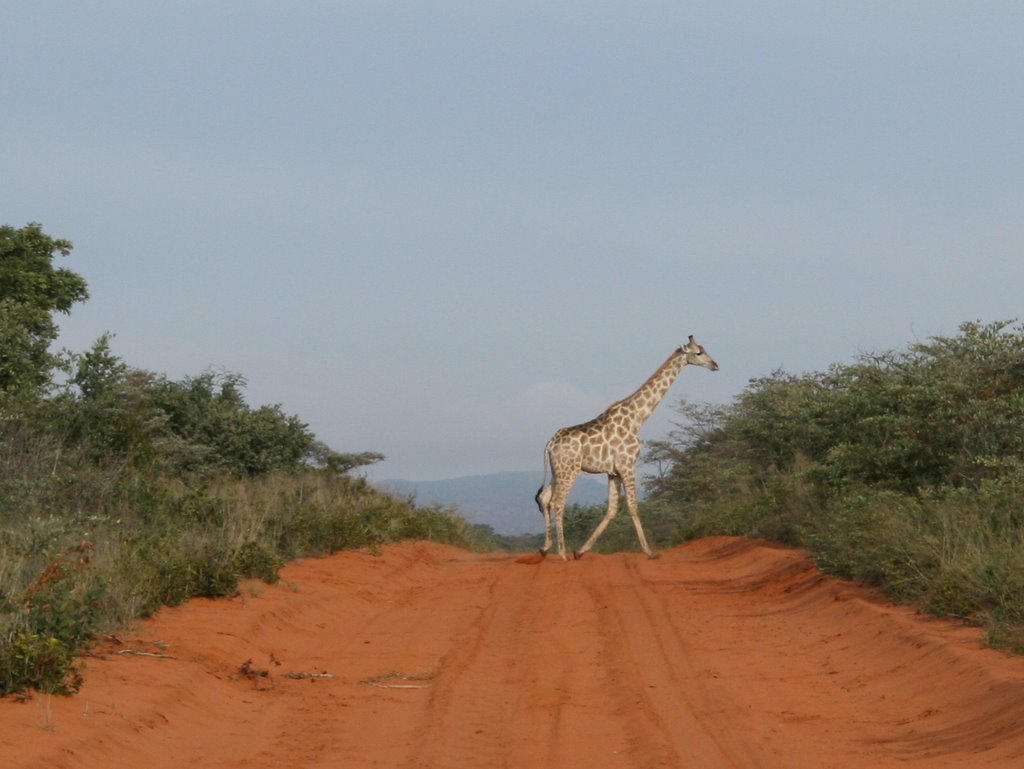
We also came across a chameleon crossing our path and spent some time observing it’s behaviour, how it continuously changes colour and puffs it’s self up to look bigger when threatened. We marvelled at the way it walks – and the kids developed their own chameleon dance, with Anna even adding dancing and song.


We left the resort and headed to a town 100 km away, with a well-known German bakery (which we read about in our tour book), for lunch on route to Estosha National Park. As we parked outside of the bakery, we noticed that one of the NWR game vehicles was pulling in behind us. Two of the Waterberg resort workers came over to our van and started to explain how they had been trying to get a hold of us (essentially tracking us), since there had been a mistake made. We had no clue what they were talking about, but eventually we came to learn that they had ‘double-charged our credit card for $4000 Rand, instead of $ 2100 Rand’, and were ‘tracking’ us to give us the money back. They did not know our route plans, but had deduced that if we were not going to the Bakery (obviously this is a hot-spot for tourists), then Windhoek (a 300+ km drive) would likely be where we would stop for gas. When I asked them if they would have driven to Windhoek to give us the money back, they looked at us with all sincerity and said, yes of course. They handed us the $2000 Rand cash ($300 Cnd) with apologies of the accounting error, of which we gave them back $300 R ($45 Cnd), and wished them safe travels on their return trip back to Waterberg. We suspect that the daily animal tracking skills also helps tracking down other species when required!
Wednesday, April 14, 2010
SWAKOPMUND - An Adrenaline Sports Town


Our drive from Sesriem lead us along a dry, desert gravel road for 100 km with the landscape changing from desert to moonscape desert (no vegetation!). Somewhere in the middle of this isolated and dusty drive, we encountered a group of local Namibians on the road, and their older model pickup truck, with obviously some vehicle problems. We slowed down (with hesitation), rolled down the windows, and one of the men explained in broken English that their truck gas line had a leak and they were out of gas, in the middle of the road, in the heat of the day. With some intrepidation, we offered one man a ride to the closet town (Solitaire) to get gas. The man got into our caravan with empty plastic oil can in hand, and off we went. It was the quietest 50 km of driving to date, with the kids (and us) watching this stranger in our van carefully – and with the Namibian staring intently out the front window. You hate to feel so suspicious, but travelling in a foreign land, with a whole new set of cultural experiences, can bring out fear and terror, that is not related to really any concrete experience. Of course, everything went well and the man was extremely grateful, and as fate would have it, we rolled into the Solitaire gas station with a flat tire ourselves. A flat tire at a service centre is a $200 new tire and 15 minutes of time. A flat tire on the isolated gravel road we had just driven would have been numerous hours of figuring out how the spare works, jacking up the caravan and 6 hot, exhausted and cranky people. Let’s just say, we felt that it was the luckiest flat we have ever had. Given the 1000's of km of gravel road we have driven with a caravan full to the brim, one flat tire thus far has been a minor event. Mostly we see well equipped 4x4 vehicles on the road, so our ‘luxury’ van is really quite a site rolling through some of these small villages, and people stop, stare and point in some cases (likely also wondering why we don't have at least 40 people inside).


Solitaire is really nothing more than a gas station, shop, small lodge and amazing famous bakery – which of course we all had to try. Moose Macgregor (yes a Scot, and that is his real name!), bakes the best apple pie (applestrudel) and homemade breads, scones, and pastries. He is an enormous guy, with a comment about everything, and knows a little bit about the world from the travellers he encounters. He told me about the famous ‘Moose of Canada’, and how he received some maple syrup sent to him from a customer on their return to Canada (may have been a subtle hint to me). We stopped at the Tropic of Capricorn - took the obligatory photo and rushed out of the dry, desert heat and blistering sun back to our van. At the coast, we stopped off at Walvis Bay along the coast and had a nice lunch at the waterside. Ben’s school collects bikes to send to this town, so he will have to report what he saw there when he returns to his class.
We arrived in Swakopmund late afternoon and headed straight to the bank, grocery store and laundry shop (yes, we still have to do these mundane tasks even on an exotic trip). We had not done any laundry since we picked up the caravan, so essentially everything needed cleaning. The great news was you drop it off, and return a few hours later with everything washed, cleaned and folded for you – all for a few dollars. This is the result of an abundance of labour around and low wages. You essentially see several people working everywhere you go: if you use a toilet, there is a woman inside to clean up; if stop at a service station to gas up there is always service to clean your entire car by hand – inside and out; camping grounds are spotless and orderly and most buildings well kept and clean. The people seem happy enough to be employed and are certainly very hard workers, they also seem genuinely happy to have foreigners come and add to the revenue base of the country. Swakapmond is an old German town, with many of the historic buildings still in place. It is a heavily visited tourist town, which offers a variety of adrenaline sports – yippee. We booked ourselves into sand boarding down the dunes, ATV’ing, go-carting and paragliding; all of which seemed to keep all members of the family happy. Sandboarding is essentially strapping on a gear of a snowboarder and riding the sand dunes. We booked our trip with Alter Action, run by a woman Beth from San Fransisco, who came to this area 16 years ago and never left. For Sam and Anna, they did the equivalent of tobogganing on a waxed up board to soar down the dunes. It is all great fun – but the slog back up the dunes (no lifts here), in the heat can be exhausting. We got some great photos and movies of the event, and left with even more of the Namibian sand in various crevasses of our bodies! Quad-biking/ATV’ing over and around the sand dunes was also a huge hit (especially for the kids). We rented for 2 hours with a guide for the Sundowner tour and cracked open a bottle of bubbly on the top of the dune as the sun set. The boys started the first 2 hour trip with the automotic vehicles, with Sam and Anna riding with us; but by the second day (and second 2 hour rental) Ben and David had graduated to manual vehicles, and Sam and Anna essentially drove John and myself around! Later in the evening, we had a lot of discussion about when they could get their drivers licence and why we do not have ATVs at our house. Sam said if he had an ATV at home, he would ATV to school by himself everyday – while David has decided on a career as an ATV tour guide in Namibia (which was probably partly due to the great guide we had Tondo, who really enjoyed the boys ‘zest’ for adventure). We had a half day instruction and session on paragliding off the dunes, where we glided ourselves (not tandem with instructor), over the dunes and towards the sea. We had a hippie instructor Mario, who at the beginning we were really unsure of (seeing that he arrived to pick us up in his 70’s VW combi and proceeded to try to explain that there had been a big party the night before and his ‘lander’ was to hungover to help, so he brought another guy he was ‘training’), but Mario won us over when he showed us that he was a well seasoned pilot and good teacher (although his language was a bit foul). We glided with another family from Germany and their 3 older boys and had some time to talk about their trip to Botswana which they completed 5 years ago (when their youngest was 6). It has been nice to pick up a few ideas and tips from others who have travelled through the area. We stayed at the Alte Brucke resort, another lodge and camp location with buffet breakfast included, again spotless (German run), with your own camp site bathroom with shower, outdoor kitchen area and braai area at each camp location. We were exhausted at the end of each day and had a few good meals in town. We left Swakapmond with a new found appreciation for some great sports, and a love for the Atlantic Ocean parallel to the dry, ocean dunes that border the area. Next stop, Etosha National Park for some wildlife viewing!


Monday, April 12, 2010
Namibia – Namid Desert - ‘Namid’ - Vast Dry Plain
Namibia – Namid Desert - ‘Namid’ - Vast Dry Plain
Our route up to Namibia, took us beside the Cedarberg Mountains, which led us over a few montain passes and allowed us to experience some of the vistas. We overnighted in Clanwilliam, in a camp resort at the dam, beside the lake. The resort was full with many Cape Town locals enjoying the end of the Easter weekend, with their boats rigged out for water sports such as waterskiing, tubing, fishing. Given our abundance of beautiful Canadian lakes, it was not so impressive to us, but to the locals, this fresh, clear, blue water was paradise. We rolled out of the campsite relatively early (any transition seems to take us longer than we would like, but were starting to get a bit more efficient!) to start our trek to the Namibian border. We stopped off in Springbok for a late lunch and to learn a bit of the history of copper and diamond mining of the region. Diamonds were first discovered by South African labourer in 1890, at the surface of the land. The first diamond finds in this area were reported to be at the surface and washed into the shoreline by the Bengula currents. In 1910, the Germans (who declared the area as part of the German empire - German West South Africa) branded the entire area between Luderitz and the Orange River Sperrgebiet (closed). Germany, however never benefitted from diamond find, because WW1 in 1914 ended the colonial rule of German South West Africa. Currently it is reported that there exists billions of carats of diamonds in the area, which is controlled by South Africa. No one really knows, since there is no admittance to the region, so accurate estimates do not exist. We spent some time rummaging through some semi-precious stones that were purchased by the kilo, and left Springbok with a little more understanding of the industry. On our drive north, we passed several herds of Springbok, Gemsbok, and in a small flooded area of the road, we encountered our first BIG African snake. We drove slowly along side and all decided we certainly would not want to accidently encounter one of these reptiles. The boys have been fascinated with the deadly and dangerous snakes found in the region. We picked up a snake field guide and they have been practising their identification skills. Let’s hope we do not need to put this skill into action.
We arrived at the border late afternoon, and were greeted by a customs officer at the van, who handed us a slip of white paper, and told us to gather our documents and proceed to “Door #1, then Door #3 and then Door #4”. We left the vehicle and started the long-line and wait of customs. Of course, like with many hot countries, a lot of buildings are outdoors, and in the heat of the day – a long line, with many people can be exhausting and overwhelming. We completed the 3 different “doors”, where at each step we were asked a series of questions, filled out some customs forms, and then paid a road tax – and at the end we were told to place the white slip in an outdoor small white ballot box. I am not still sure what the point of the exercise was, and I wonder who reviews the slips, but we crossed the border successfully and we were in Namibia.
We overnighted at Fish River Canyon Roadhouse and arrived about an hour after dark, after a series of gravels roads. The last hour of driving after sunset was not the best of trips, since the gravel roads at night can be taxing and the caravan is a bit of a boat to manoeuvre. We decided to stay in the lodge (in two proper hotel rooms) and treated ourselves to a nice dinner at the restaurant. The Roadhouse Lodge is a crazy bit of automobile nostalgia, attempting to recreate the famous Route 66 (Cars movie?). In the morning we headed straight out to Fish River Canyon. Second to the Grand Canyon, this is an immense gorge (Fish River) which joins Orange River to the south. The canyon measures 160 km in length and is 27 km in width with a depth of 550 m. There is a road which runs along the side of the canyon, and several viewing spots, so it is easy to get different perspectives of its immensity. Other than looking over the side, there is little to do, since hiking into the canyon for a day basis has been stopped. Five day hikes and excursions into the canyon, from Ais-Ai (the south point of the canyon where the hotsprings are located) to Hobas (an 85 km route) are Namibia’s most popular hiking trip (note for my fellow hiker friends!).
We left at lunch and routed North attempting to reach Sesriem. At dusk, we decided that our ambitious plan would involve several hours of night driving, so we overnighted at a camp spot in Bette. We have discovered that Namibia is a campers heaven, practically everywhere you go there is a campspot available, and all of them to date have been well-set up and with very clean and modern showers, bathrooms, hot and cold water, cooking facilities, and washing areas. Some are run by the Namibia Wildlife Resorts (similar to our BC Parks) and other by private individuals with large farm areas, who supplement their income with camp sites. On average the price is $15/night and some offer dinners and “packed lunches” for nominal costs too. With the weather dry, days warm and nights cool, let’s just say it is not to hard to camp here. The caravan is fully set up, and it is saving us some precious time on unpacking/packing and the sleeping arrangements are reasonable. The kids have enjoyed the freedom of movement during our travel, and have occupied themselves during the long road stretches with roadside viewing, DVD movies and games. We have a bathroom on board, which we tend not to use unless an emergency (which of course with four young kids does happen), but the kitchen with fridge, freezer, plug-ins, and stove has been a life-saver. We tend to try and travel with our cupboards and fridge full, so everyone can help their selves along the way. Needless to say, this is the only travel vehicle that could accommodate our family, so we could not comment on the tent/vehicle set ups that are seen throughout the area. As far as off-roading, the vehicle has been fine on all the roads travelled thus far (most gravel and potted), however everything is relatively dry and we have certainly noticed large flood plains on many of the roads, which would lead us to believe that if this was the rainy season we would be in trouble.

We arrived at Sesriem mid-afternoon. Sesriem, is the gateway to Sossusvlei, home to one of the world’s oldest and driest dune ecosystem. Staying at the NWR park, which is inside of the gates, allows you first access to see the sunrise over the dunes, so without a reservation, we were happy to book two nights at the camping resort. We arrived at high afternoon and immediately noticed the intensity of the heat, the resort workers reported that it was 40C, and was so hot and dry that even with the wind it feels like a blow-dryer set at high heat. We parked under a large tree and proceeded to the swimming pool, where we all cooled off and took shelter in the shade.
We ended the night with a campfire, built by Ben who has taken lead charge in setting up anything related to camping, and sat under the African starry sky to watch for shooting stars . The stars in the sky are unlike any night ski we have witnessed, the Milky Way (and its thumbprint Mesna) is clearly visible, and the billions of stars, planets, comets and other cosmic features stretch from horizon to horizon. The stars spread out so low in the horizon, that the kids think they are lights from some distance towns. It is has been rewarding to enjoy some of the simple, natural things together and it certainly is reinforcing our respect for the ‘wonders of nature’.


We left our campsite at 5 am to trek the 50 km (by road) to Sossusvlei to witness the sunrise over the sand dunes. The kids slept soundly in their beds during our drive, and did not stir when we arrived at Dune 45. John proceeded to hike the dune (he won the coin toss), while the kids slept and I made coffee. Within 5 minutes of his departure, everyone was up and racing to catch up to Dad. We bounded down the dunes (David turning his 360’s and front flips along the way). We all enjoyed a wonderful (cool) morning on the dunes and watched the desert come to life. These Namib Dunes are classified as parabolic and dynamic, shifting constantly with the wind allowing them to be continuously sculpted into new shapes. The top portion of the dune is formed by the fine sand blown over the crest and slipping down the other side, which continuously shifts the crest and shape of the dune. In the morning light, the sun facing dune slope lights up slowly to a deep orange-red colour, with the shade side in the dark. The experience of watching the sunrise on the dune is one we will not soon forgot. We were back at camp by 10 am, swam, drank, ate, rested then headed for a Sundowner on the dunes. We arrived at the top just in time to see the sun set behind of ever changing, orange sand, dunes. The sky turned a burnt orange as the sun sank behind the horizon, and Venus appeared low in the sky. We returned back to our camp for a braai dinner (local game sausages) and chicken kebobs then showered in an attempt to get some of the sand out from all the crevasses of our bodies! I think we will be travelling for the rest of the trip with a bit of the Soussusvlei dunes.
Our route up to Namibia, took us beside the Cedarberg Mountains, which led us over a few montain passes and allowed us to experience some of the vistas. We overnighted in Clanwilliam, in a camp resort at the dam, beside the lake. The resort was full with many Cape Town locals enjoying the end of the Easter weekend, with their boats rigged out for water sports such as waterskiing, tubing, fishing. Given our abundance of beautiful Canadian lakes, it was not so impressive to us, but to the locals, this fresh, clear, blue water was paradise. We rolled out of the campsite relatively early (any transition seems to take us longer than we would like, but were starting to get a bit more efficient!) to start our trek to the Namibian border. We stopped off in Springbok for a late lunch and to learn a bit of the history of copper and diamond mining of the region. Diamonds were first discovered by South African labourer in 1890, at the surface of the land. The first diamond finds in this area were reported to be at the surface and washed into the shoreline by the Bengula currents. In 1910, the Germans (who declared the area as part of the German empire - German West South Africa) branded the entire area between Luderitz and the Orange River Sperrgebiet (closed). Germany, however never benefitted from diamond find, because WW1 in 1914 ended the colonial rule of German South West Africa. Currently it is reported that there exists billions of carats of diamonds in the area, which is controlled by South Africa. No one really knows, since there is no admittance to the region, so accurate estimates do not exist. We spent some time rummaging through some semi-precious stones that were purchased by the kilo, and left Springbok with a little more understanding of the industry. On our drive north, we passed several herds of Springbok, Gemsbok, and in a small flooded area of the road, we encountered our first BIG African snake. We drove slowly along side and all decided we certainly would not want to accidently encounter one of these reptiles. The boys have been fascinated with the deadly and dangerous snakes found in the region. We picked up a snake field guide and they have been practising their identification skills. Let’s hope we do not need to put this skill into action.
We arrived at the border late afternoon, and were greeted by a customs officer at the van, who handed us a slip of white paper, and told us to gather our documents and proceed to “Door #1, then Door #3 and then Door #4”. We left the vehicle and started the long-line and wait of customs. Of course, like with many hot countries, a lot of buildings are outdoors, and in the heat of the day – a long line, with many people can be exhausting and overwhelming. We completed the 3 different “doors”, where at each step we were asked a series of questions, filled out some customs forms, and then paid a road tax – and at the end we were told to place the white slip in an outdoor small white ballot box. I am not still sure what the point of the exercise was, and I wonder who reviews the slips, but we crossed the border successfully and we were in Namibia.
We overnighted at Fish River Canyon Roadhouse and arrived about an hour after dark, after a series of gravels roads. The last hour of driving after sunset was not the best of trips, since the gravel roads at night can be taxing and the caravan is a bit of a boat to manoeuvre. We decided to stay in the lodge (in two proper hotel rooms) and treated ourselves to a nice dinner at the restaurant. The Roadhouse Lodge is a crazy bit of automobile nostalgia, attempting to recreate the famous Route 66 (Cars movie?). In the morning we headed straight out to Fish River Canyon. Second to the Grand Canyon, this is an immense gorge (Fish River) which joins Orange River to the south. The canyon measures 160 km in length and is 27 km in width with a depth of 550 m. There is a road which runs along the side of the canyon, and several viewing spots, so it is easy to get different perspectives of its immensity. Other than looking over the side, there is little to do, since hiking into the canyon for a day basis has been stopped. Five day hikes and excursions into the canyon, from Ais-Ai (the south point of the canyon where the hotsprings are located) to Hobas (an 85 km route) are Namibia’s most popular hiking trip (note for my fellow hiker friends!).
We left at lunch and routed North attempting to reach Sesriem. At dusk, we decided that our ambitious plan would involve several hours of night driving, so we overnighted at a camp spot in Bette. We have discovered that Namibia is a campers heaven, practically everywhere you go there is a campspot available, and all of them to date have been well-set up and with very clean and modern showers, bathrooms, hot and cold water, cooking facilities, and washing areas. Some are run by the Namibia Wildlife Resorts (similar to our BC Parks) and other by private individuals with large farm areas, who supplement their income with camp sites. On average the price is $15/night and some offer dinners and “packed lunches” for nominal costs too. With the weather dry, days warm and nights cool, let’s just say it is not to hard to camp here. The caravan is fully set up, and it is saving us some precious time on unpacking/packing and the sleeping arrangements are reasonable. The kids have enjoyed the freedom of movement during our travel, and have occupied themselves during the long road stretches with roadside viewing, DVD movies and games. We have a bathroom on board, which we tend not to use unless an emergency (which of course with four young kids does happen), but the kitchen with fridge, freezer, plug-ins, and stove has been a life-saver. We tend to try and travel with our cupboards and fridge full, so everyone can help their selves along the way. Needless to say, this is the only travel vehicle that could accommodate our family, so we could not comment on the tent/vehicle set ups that are seen throughout the area. As far as off-roading, the vehicle has been fine on all the roads travelled thus far (most gravel and potted), however everything is relatively dry and we have certainly noticed large flood plains on many of the roads, which would lead us to believe that if this was the rainy season we would be in trouble.

We arrived at Sesriem mid-afternoon. Sesriem, is the gateway to Sossusvlei, home to one of the world’s oldest and driest dune ecosystem. Staying at the NWR park, which is inside of the gates, allows you first access to see the sunrise over the dunes, so without a reservation, we were happy to book two nights at the camping resort. We arrived at high afternoon and immediately noticed the intensity of the heat, the resort workers reported that it was 40C, and was so hot and dry that even with the wind it feels like a blow-dryer set at high heat. We parked under a large tree and proceeded to the swimming pool, where we all cooled off and took shelter in the shade.
We ended the night with a campfire, built by Ben who has taken lead charge in setting up anything related to camping, and sat under the African starry sky to watch for shooting stars . The stars in the sky are unlike any night ski we have witnessed, the Milky Way (and its thumbprint Mesna) is clearly visible, and the billions of stars, planets, comets and other cosmic features stretch from horizon to horizon. The stars spread out so low in the horizon, that the kids think they are lights from some distance towns. It is has been rewarding to enjoy some of the simple, natural things together and it certainly is reinforcing our respect for the ‘wonders of nature’.


We left our campsite at 5 am to trek the 50 km (by road) to Sossusvlei to witness the sunrise over the sand dunes. The kids slept soundly in their beds during our drive, and did not stir when we arrived at Dune 45. John proceeded to hike the dune (he won the coin toss), while the kids slept and I made coffee. Within 5 minutes of his departure, everyone was up and racing to catch up to Dad. We bounded down the dunes (David turning his 360’s and front flips along the way). We all enjoyed a wonderful (cool) morning on the dunes and watched the desert come to life. These Namib Dunes are classified as parabolic and dynamic, shifting constantly with the wind allowing them to be continuously sculpted into new shapes. The top portion of the dune is formed by the fine sand blown over the crest and slipping down the other side, which continuously shifts the crest and shape of the dune. In the morning light, the sun facing dune slope lights up slowly to a deep orange-red colour, with the shade side in the dark. The experience of watching the sunrise on the dune is one we will not soon forgot. We were back at camp by 10 am, swam, drank, ate, rested then headed for a Sundowner on the dunes. We arrived at the top just in time to see the sun set behind of ever changing, orange sand, dunes. The sky turned a burnt orange as the sun sank behind the horizon, and Venus appeared low in the sky. We returned back to our camp for a braai dinner (local game sausages) and chicken kebobs then showered in an attempt to get some of the sand out from all the crevasses of our bodies! I think we will be travelling for the rest of the trip with a bit of the Soussusvlei dunes.
West Coast South Africa
WEST COAST SOUTH AFRICA

We spent a good part of the day organizing, packing up our place in Stellenbosch, driving back to Cape Town, dropping off our rental van and picking up the motorhome that we will be travelling with for the duration of the trip. By the time we got on the road, it was late afternoon of the Thursday of Easter weekend, and we had no accommodation booked. Our original plan was to head to the Cedarberg Mountains, but a few phone calls to camp locations told us the long weekend was completely booked. As fate would have it, we decided to stick along the coast and found a great beachside camping area at Yzerfontein, at least 150 km north of Cape Town (slowly making some progress North). At the site we were able to enjoy the last of the sun on the beach, with the kids jumping off the sand dunes, and marveling at the fine, white sand and long beach coastline.

The next day, we headed north to West Coast National Park, which encompasses the clear, blue waters of the Langebaan Lagoon and is home to an enormous migratory bird colonies. We drove up both arms of the Lagoon, and stopped at the information centre to learn more about the other species within the park, including the six venomous snakes (one that spits “the spitting Cobra”), turtles, ostriches, gemsbok, springbok. We also read and saw “Eve’s footprint”, a footprint found along the shoreline that dates back 117,000 years ago. The centre also has a Cape Dutch building dating back to 1744 (which houses a resturant and curio shop). We hiked out over the Lagoon, to one of the many bird houses, that have been established along the lagoon shoreline, and sat in the hut pretending we knew something about birdwatching. The land and huts were purchased through a donation by Elizabeth Harding, daughter of the Rhodes Fruit Company – England, who came to South Africa, fell in love with the land, and lived in Cape Town till she died in the early 1990s. The kids were not so enthused about the bird watching, but enjoying seeing the Flamingos and the African Spoonbill (which Anna thought was also in one of the Pixar films).

We headed further up the coast and stumbled into Langebaan, a true west coast surfers paradise, and luckily found accommodation for two nights. Langebaan is a surfers dream, large sandy beaches, steady surf and lots of wind. There is windsurfing, kiteboarding, surfing, great sailing, and fishing. With the skies clear and the surf up, we felt right at home. We watched in awe at the kite surfers and the boys rented some windsurfing gear (Cape Town Sports) and John spent a few hours teaching Ben and David the sport. Windsurfing is not a sport that is learnt in an afternoon, so needless to say there were some frustrating moments. We enjoyed some good seafood at the Driftwood Beach house, and bought some local Cape Yellowfin to “braai” ourselves. I don’t think we have mentioned all the talk about the braai (which is essentially the open-wood barbeque). This seems to be a huge part of the South African culture, and certainly is the way to entertain here. We are slowly getting accustomed to some of the Afrikaans language and routines, including the biltong (dried meat), boerewors (BBQ sausages), potjiekos (pot food) and Dankie (thank you!). David has thoroughly enjoying the African element of no shoes, and walks to mos places without footwear. Most SA’s speak the 2 languages fluently, so getting around has been easy and the kids have made friends everywhere we land. We would certainly recommend Langebaan to anyone who loves sea sports and beach life, and there seems to be a lot of vacation rental houses along the beach and walking distance to the town. We ended our stay on the coast with an Easter Sunday catamaran tour and enjoyed the coastal view from the water.


We spent a good part of the day organizing, packing up our place in Stellenbosch, driving back to Cape Town, dropping off our rental van and picking up the motorhome that we will be travelling with for the duration of the trip. By the time we got on the road, it was late afternoon of the Thursday of Easter weekend, and we had no accommodation booked. Our original plan was to head to the Cedarberg Mountains, but a few phone calls to camp locations told us the long weekend was completely booked. As fate would have it, we decided to stick along the coast and found a great beachside camping area at Yzerfontein, at least 150 km north of Cape Town (slowly making some progress North). At the site we were able to enjoy the last of the sun on the beach, with the kids jumping off the sand dunes, and marveling at the fine, white sand and long beach coastline.

The next day, we headed north to West Coast National Park, which encompasses the clear, blue waters of the Langebaan Lagoon and is home to an enormous migratory bird colonies. We drove up both arms of the Lagoon, and stopped at the information centre to learn more about the other species within the park, including the six venomous snakes (one that spits “the spitting Cobra”), turtles, ostriches, gemsbok, springbok. We also read and saw “Eve’s footprint”, a footprint found along the shoreline that dates back 117,000 years ago. The centre also has a Cape Dutch building dating back to 1744 (which houses a resturant and curio shop). We hiked out over the Lagoon, to one of the many bird houses, that have been established along the lagoon shoreline, and sat in the hut pretending we knew something about birdwatching. The land and huts were purchased through a donation by Elizabeth Harding, daughter of the Rhodes Fruit Company – England, who came to South Africa, fell in love with the land, and lived in Cape Town till she died in the early 1990s. The kids were not so enthused about the bird watching, but enjoying seeing the Flamingos and the African Spoonbill (which Anna thought was also in one of the Pixar films).

We headed further up the coast and stumbled into Langebaan, a true west coast surfers paradise, and luckily found accommodation for two nights. Langebaan is a surfers dream, large sandy beaches, steady surf and lots of wind. There is windsurfing, kiteboarding, surfing, great sailing, and fishing. With the skies clear and the surf up, we felt right at home. We watched in awe at the kite surfers and the boys rented some windsurfing gear (Cape Town Sports) and John spent a few hours teaching Ben and David the sport. Windsurfing is not a sport that is learnt in an afternoon, so needless to say there were some frustrating moments. We enjoyed some good seafood at the Driftwood Beach house, and bought some local Cape Yellowfin to “braai” ourselves. I don’t think we have mentioned all the talk about the braai (which is essentially the open-wood barbeque). This seems to be a huge part of the South African culture, and certainly is the way to entertain here. We are slowly getting accustomed to some of the Afrikaans language and routines, including the biltong (dried meat), boerewors (BBQ sausages), potjiekos (pot food) and Dankie (thank you!). David has thoroughly enjoying the African element of no shoes, and walks to mos places without footwear. Most SA’s speak the 2 languages fluently, so getting around has been easy and the kids have made friends everywhere we land. We would certainly recommend Langebaan to anyone who loves sea sports and beach life, and there seems to be a lot of vacation rental houses along the beach and walking distance to the town. We ended our stay on the coast with an Easter Sunday catamaran tour and enjoyed the coastal view from the water.


Stellenbosch - Yummy wines and mountain biking


Shortly out of Cape Town, along the highway, we saw our first Townships. These are shanty town communities originating in Apartheid das, built along the roadside or less desirable land locations. Children played in and out of the lean-to fences, while tin roofs were held down with long pieces of waste wood, used tires and general large debris. There was a whole series of electrical wires, running above the homes, seeming to have no real order to how they were placed. Certainly a stark contrast to the structured and orderly, Colonial Dutch-style homes within the city areas, and the kids began to refer to these areas as “District 9”, from the movie. If you have seen this movie, you may be able to relate to how and why these communities were established. Regardless of living circumstance, the community tended to go on their daily business; laundry on the line, children playing and adults meandering around. Another interesting observation was the number of people walking; on most roads and highways people are walking along the side - using walking a a viable (yet slow) mode of transportation. Locals in cars, use the ultimate ride-share program, stacked full with people, one pickup truck may have 15 people in total, in the front and back, of all ages; grandmas, parents, children and babies. It really looks quite hazardous when you are travelling along the motorway at 120 km/hr.
We reached Stellenbosch and checked into our ‘home’, at Devondale Lodge, a winery and golf course development. The 25 units are mostly owned and used as secondary winter homes, with 4 remaining in a rental pool. The unit was very spacious, with 2 living levels and a backyard and patio that faced a large courtyard pool. The development was lacking the old-world charm, since it had been built in 1995, but what it lacked in charm, it made up in practicality. The kids befriended a local family, next door to us, daughter to the owners (Provoyeurs), who had a 4 year old son (Oliver) and a 4 month old puppy (Monty). Soon everyone was good friends. We learnt that the developers of the property were Olympic sailors (including the 1994 BOC Around the World, single handed yacht race), and decided to retire here and develop the property. Like most of the surrounding area, the land has a gentle slope, surrounded by mountain ranges. Stellenbosch, is most famous for the Wine Route, which consists of an integrated series of over 200 wineries within a close range from the centre of the town.
Wine touring, tasting and 4 young children did not seem like a compatible combination, so we attempted to fill our few days with mainly child friendly activities, with wine tasting as an aside. Surprisingly, the combination was quite successful. We started our activities at the Spier, a large winery with an African themed restaurant and entertainment. We knew this was a good choice from the entry, with all of us getting face-painted (Zulu style) and outdoor tent and tree-top dining. There was a large serve-yourself buffet, a series of entertainers which roamed tables to perform, and generally an abundance of loud, African-style evening activities. I am sure a few people would consider this “commercial” level of African culture, a little obnoxious, but for us it kept the kids entertained and gave us an introduction to the sights, sounds and tastes African culture.


Our next day consisted of a drive to Boschendale, an estate winery founded in 1665, and a wonderful example of colonial Dutch architectural. The estate has lovely grounds and offers a famous “Pique-Nique” lunch in the front lawn. The lunch is a wonderful concept of seating yourselves out under the shade of the trees, and having individually packed picnic baskets brought to you. The kids lunch packs are served in a hobo-basket and pole, which delighted all of them. The adults are equally content, with a bottle of white wine and a basket of goodies - pates, baguette, cold cuts, cheese, etc. We played an informal game of rugby on the lawn and enjoyed the afternoon.


We left from here and arrived at Villiera, where we had booked our first game tour. This family winery (Grier) has decided to use some of their lands and re-establish native plants and species to the reserve. Alexander Grier, our tour guide, was helpful in explaining how the Wildlife sanctuary reserve is established, which requires applications and approvals for every animal, with subsequent monitoring of the herds and how they are developing. Animal conservation in Africa has become very regulated and monitored affair (thank goodness, since some species were hunted to extinction!). We had our own private tour around the reserve and saw Springbok, gemsbok, wild pigs, zebras, and many birds.

The next day, we ventured off for a bike tour with Ben, David and Anna, while Sam was invited to stay with his new friend, Oliver, for the afternoon. We headed to Delvera, where the Biketopia centre was located and geared ourselves with Mountain Bikes for our tour. Delvera is a small artist-like community, adjacent to the Klapmutskop Conservancy, where there is a bike park, trails, craft stores, and art shops, all in the surrounds of pastoral land. We started our event with a great outdoor lunch, where we sampled Bobotie, a local meat-curry dish (yummy!), prior to our 10km ride. The bike trails were a combination of riding through the vineyards, single track trails through the hillsides and some technical ladders in a forested area. Perfect for Ben and David, yet a little challenging for Anna. On the whole, it was a beautiful ride and we all returned back to Delvera with smiles. Of course, we stopped by the wine shop, which hosts over 600 local wines of the region, and spent time with the sommelier who picked and packed a 12 bottle variety of the Sauvignon Blancs for us to leave with (they also ship worldwide!). Each bottle, as it was selected, was explained in great detail, including the winery it is produced from and the history of the owners. I believe that this sommelier, could have likely answered any question on all 600+ bottles! Our evening ended with a recommended drive to the “winery in the sky”, Delaire, a five-star incredible winery, hotel and restaurant (on the list to return to, sans enfant). We dined at Ginos, in Stellenbosch, an Italian eatery with great homemade pizza, pastas and calzones.

Saturday, April 3, 2010
Sorry folks - it's been a while since we last updated. We've been busy, and much to report - from Stellenbosch wine country and game tours, to the Wild West Coast of South Africa as we've started our route up to Namibia in a camper van. There's been very little internet access, and haven't had a moment to get into an internet cafe, so this is the first chance we've had to update with a quick note. There'll be more added shortly with photos, etc.
Hope all's well - thanks for all of the comments and e-mails - lov'n them!

Hope all's well - thanks for all of the comments and e-mails - lov'n them!

Subscribe to:
Comments (Atom)

 Posts
Posts

